

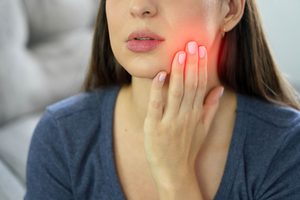
Many people know they can contact their dentist if they have issues with their teeth or gums, but if you’ve noticed that your jaw feels tight or sore, especially first thing in the morning, you might not know who to call for help.
But your oral healthcare provider is uniquely trained and has state-of-the-art technology to assess and treat a variety of mouth and jaw concerns, so they can help ease aches and restore full range of motion. Continue reading to learn about 3 potential reasons for your soreness and how your dentist might help!
Cause #1: Teeth Grinding
Bruxism, or teeth grinding, is when you subconsciously clench your upper and lower arches together. It typically happens overnight while you’re sleeping, though it can also occur during the day, and sources estimate that about 85% to 90% of people will experience it at some point in their lives.
In addition to dental damage, chronic teeth grinding can also put added pressure on the temporomandibular joints (TMJ) that anchor your jawbone to your skull. This can cause persistent throbbing that may not subside without treatment. Thankfully, many dentists offer services, like BOTOX® injections, to help relax the jaw muscles and give them a much-needed chance to rest and recover.
Cause #2: Temporomandibular Joint Disorder
The longer you wait to contact your dentist for help with your discomfort, the more likely you are to develop a TMJ disorder. If the inflamed joints never get a break, you might develop aches that radiate from your mouth to your ear, neck, or head, which can cause migraines. You might also have a stiff or locked jaw along with associated soreness.
Many dentists treat TMJ disorders with a custom-fitted occlusal splint worn over the teeth at night to cushion your arches and reduce pressure on your joints, helping ease built-up tension.
Cause #3: Sleep Apnea
Those who grind their teeth or develop a TMJ disorder may also be prone to sleep apnea, which refers to a condition in which your breathing repeatedly stops and restarts at night, which interrupts your natural sleep cycles. This can cause daytime exhaustion, moodiness, and increase the risk of heart problems or stroke.
Obstructive sleep apnea, the most commonly diagnosed type, often occurs when the jaw is misaligned, which restricts the airways and prevents oxygen from reaching the lungs, brain, or bloodstream. Your dentist can provide an equilibration, also known as occlusal adjustment, by slightly altering the biting surfaces of your teeth to ensure they touch correctly when you bite down. This can help correct your jaw’s position and keep your airways open while you snooze.
Once your dentist examines your condition, they can devise a customized treatment plan to alleviate your symptoms based on their findings!
Meet the Author
Dr. Tristan J. Parry is an accomplished sleep and TMJ dentist who strives to improve patients’ lives by improving their dental health to relieve aches and other symptoms. He earned his Doctor of Dental Surgery from The Ohio State University, then completed mini periodontics and mini pedodontics residencies. Today, he is a Master of the Academy of General Dentistry and has trained with some of the most respected clinicians in sleep/TMJ treatment. If your jaw feels sore when you wake up in the morning, you can request an appointment on the website or call (336) 644-2770.